Late Coming Rules: Grace Time, Late Marks and Half Days Explained
Every company has a late coming policy — but in many, it lives in someone's head. That's when it turns into arguments: one person gets a half day cut for coming in at 9:40, another doesn't. A clear policy has four parts: grace time, late marks, a half-day cutoff and early going.
1. Grace time
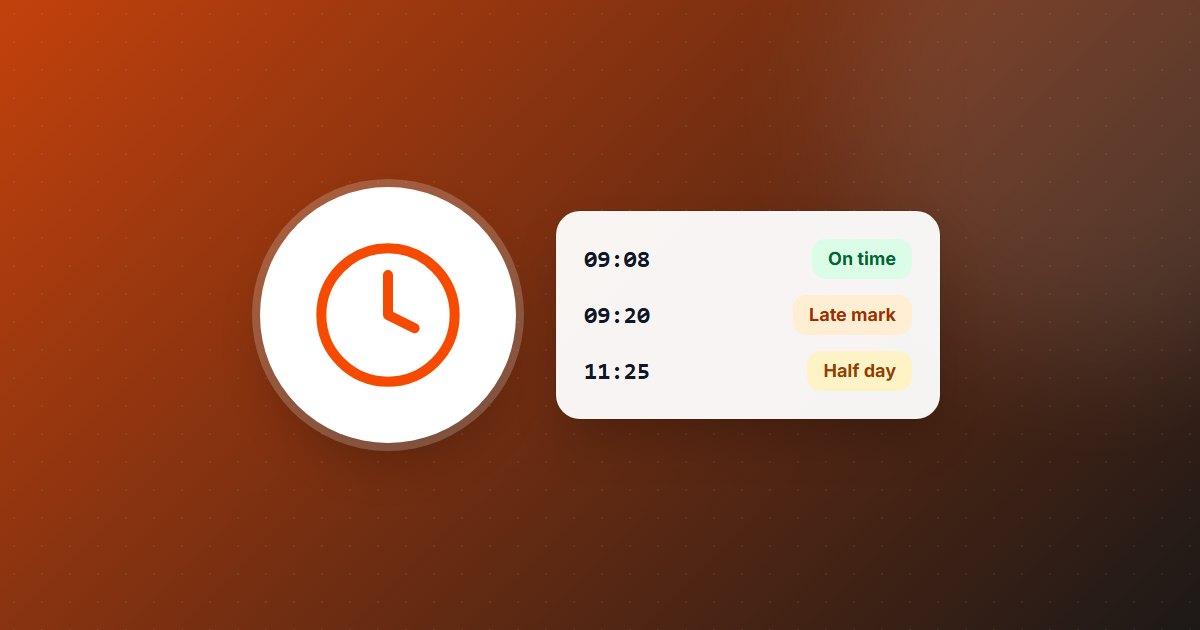
Grace time is the window after shift start in which a punch still counts as on time. Many companies use somewhere between 5 and 15 minutes. With a 9:00 shift and 10 minutes of grace, a punch at 9:09 is on time and 9:11 is late.
2. Late marks
A punch after the grace time earns a late mark. On its own, one late mark usually costs nothing — the point is to count them. A common rule is that a certain number of late marks in a month (often three) adds up to a half day deducted, and more add further deductions.
3. When lateness becomes a half day
Separately, very late arrival is often treated as a half day straight away — for example, coming in more than two hours after shift start. The same logic usually applies to leaving early: going home well before shift end counts as a half day.
A worked example
Shift 9:00 – 18:00, grace 10 minutes, 3 late marks = half day, arrival after 11:00 = half day. In one month an employee punches in:
- 9:08 on three days — on time (within grace)
- 9:20, 9:35 and 9:18 on three days — three late marks, which together make one half day
- 11:25 on one day — a half day by itself
- Everything else on time
Result: two half days for the month — one from late marks, one from very late arrival.
Keep it fair
- Write the policy down and share it before you apply it
- Apply it the same way to everyone in the same role
- Make sure the machine's clock is right — a clock that's 15 minutes fast makes everyone late
- Give people a way to raise a miss-punch or correction request
- Deduct only as the law allows: a deduction for absence must be in proportion to the time absent (Payment of Wages Act, 1936, Section 9 — now consolidated into the Code on Wages, 2019). Confirm with your HR advisor or CA
The clock point matters more than people think — read why biometric machines show the wrong time.
Let the software apply it
In Attenza, grace minutes are set per shift and the company rules include half day for late coming or early going and monthly late-mark penalties. Punches come straight from your eSSL / ZKTeco machine, the machine clock is corrected automatically, and late coming and early going reports are ready every day.
Sources
- The Payment of Wages Act, 1936 (Section 9: deductions for absence) — Ministry of Labour & Employment
- Government makes the four Labour Codes effective (21 Nov 2025) — Press Information Bureau
Rules, rates and product ranges change. Check the latest official notification or datasheet, and confirm statutory points with your CA.
Frequently asked questions
What is a reasonable grace time for attendance?
Many companies use between 5 and 15 minutes after shift start. Pick one, write it into the policy and apply it consistently.
How many late marks make a half day?
It depends on your policy. A common rule is three late marks in a month equal one half day.
Can late coming be deducted from salary?
Only according to a written policy and wage law. Deductions for absence must be in proportion to the time absent (Payment of Wages Act, Section 9, now part of the Code on Wages, 2019). Confirm with your HR advisor or CA before deducting.
Put your biometric machine on the cloud
Attenza turns eSSL / ZKTeco punches into attendance, payroll and gate logs — no PC, no static IP. Free 14-day trial.