
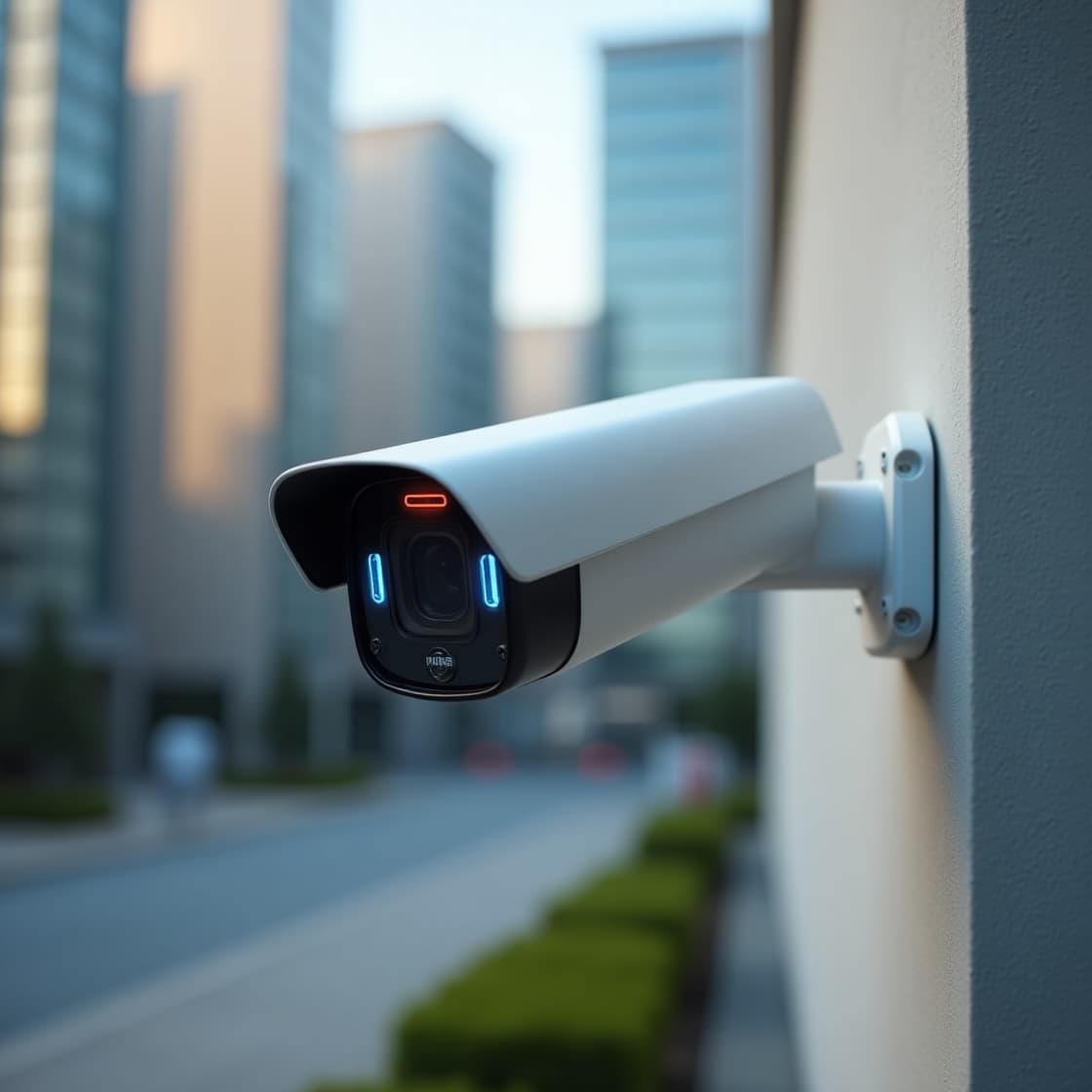
How AI Is Changing CCTV Cameras: What Mumbai Businesses Should Know in 2026
"AI CCTV camera" has become one of the most common search terms we see from customers, but the term covers a wide range of actual capability — from genuinely useful on-device analytics to marketing labels on cameras that just do basic motion detection. As an authorised dealer for Hanwha Vision, Honeywell, Matrix, Axis Communications, Panasonic i-Pro, and Pelco, here's a practical breakdown of what AI in CCTV actually means today, and where it's worth paying for.
What AI-powered CCTV actually does
- Smart motion filtering — distinguishing a person or vehicle from a moving tree branch or a cat, cutting false alerts by a large margin
- Line crossing and intrusion detection — alerts only when someone crosses a defined virtual boundary, useful for perimeter and after-hours security
- Object counting and people counting — useful for retail footfall analysis as much as security
- Facial recognition and watchlist matching — used in access control integration and high-security sites
- License plate recognition (LPR) — for gated societies, warehouses, and corporate parking management
- Loitering and abandoned object detection — increasingly used in retail and public-facing commercial spaces
Edge AI vs server-side AI
The more meaningful distinction for a buyer isn't "AI or not AI" — it's whether the analytics run on the camera itself (edge AI, like Hanwha Vision's Wisenet AI line and Panasonic i-Pro's edge-processing cameras) or require a separate server running video management software. Edge AI cameras cost more individually but need less backend infrastructure and respond faster, since there's no round trip to a central server. For a single-site office or retail store, edge AI is usually the more practical and cost-effective choice. For a large multi-building campus or a city-scale deployment — like the Mumbai Metro Aqua Line 3 project we worked on across 27 stations — server-side analytics with centralised VMS makes more sense, because you need one unified view across hundreds of cameras.
Where AI genuinely earns its cost
For most commercial and residential clients in Mumbai, the single highest-value AI feature is smart motion filtering — it's the difference between a system that pings your phone every time a leaf moves and one you can actually trust to alert you only when something matters. Beyond that, the value depends heavily on the use case: a warehouse cares about intrusion and loitering detection after hours; a retail store cares about people counting and queue analytics; a gated society cares about LPR for vehicle access; a hospital or hotel cares about facial recognition tied into visitor management.
Where AI is currently overhyped
Be cautious of "AI" claims on budget cameras with no edge processing chip — in many cases this just means basic motion detection rebranded. Genuine AI video analytics require dedicated processing hardware (an NPU or similar) either on the camera or the NVR. If a quote includes "AI features" at a price point well below comparable cameras from Hanwha, Honeywell, Matrix, Axis, Panasonic i-Pro, or Pelco, it's worth asking exactly which analytics are running on-device versus marketing language.
We can walk you through which AI features actually make sense for your site and budget — browse our current camera range or talk to our team directly for a recommendation tailored to your space.
Need a security solution for your property?
Talk to our team for a free consultation tailored to your site in Mumbai.
Get a Free Consultation